Anemone (2025)
WARNING: SPOILERS

On and off screen, Anemone is a family affair. While it’s Ronan Day-Lewis’s debut, it is his father’s first appearance on screen since the three-time Academy Award winner retired. Last among the actors appearances was a lead role in Paul Thomas Anderson’s 2017 film, Phantom Thread. On screen, Anemone sees Sir Daniel Day-Lewis appears as Ray Stoker, a retired officer of the British Special Forces, who lives secluded in Northern England. Deep in an unnamed location only accessible by exact coordinates, he has estranged himself from everyone known to him. We enter with Ray’s older brother Jem, played by Sean Bean, who comes to reconnect with him due to an ensuing family discord.
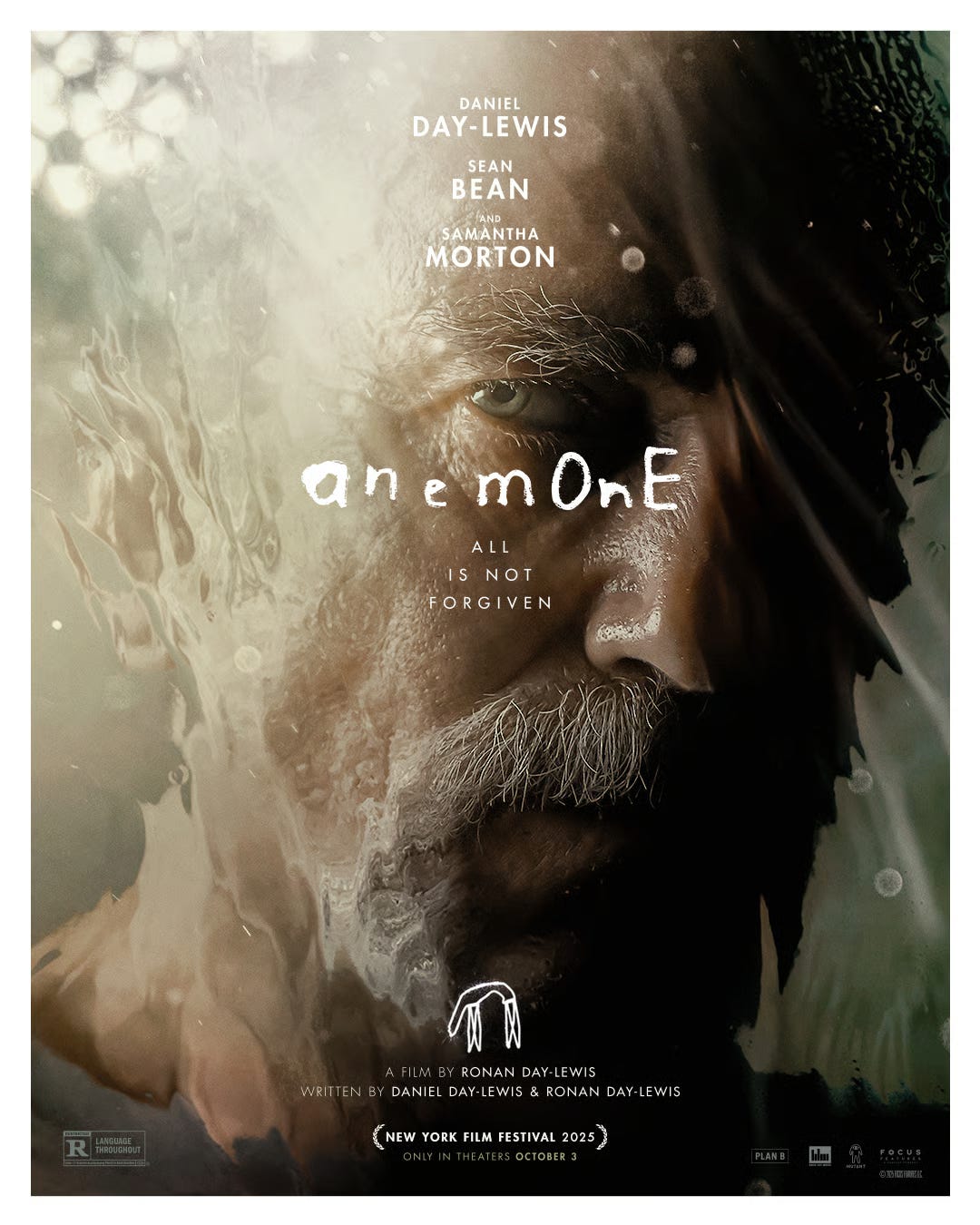
Though lush with roving glances of northern England’s forests, this isn’t a happy visit— clearly amplified by the film’s profuse blues and muddy greens. What’s important to know is that Jem’s son, Frank (Samuel Bottomley), is actually Ray’s son. Even more pertinent is that Frank has never known Ray. His knowledge of his biological father is shrouded in rumor and speculation concerning events Ray allegedly perpetrated during his tour in Northern Ireland during the early Troubles. Frank, attempting to grapple with the mere edges of a truth that everyone around him seems to know, has committed severe harm to another boy who bullies him about his parentage.
Anemone maps trauma’s and lineages on top of one another. Looking at the invisible architectures that people (particularly men) build in response to their trauma’s, it focuses on how these constructions become fortresses that we perpetrate harm from. Jem’s plea to Ray attempts to bring clarity into Frank’s life that might quell his frustrations— he knows that Frank’s anger is the product of an absence that doesn’t need to be filled, but rather understood. It’s an anger Jem knows is inherited and chooses to assuage through prayer and faith. Ray’s solace, on the other hand, is its own kind of prayer against inheritance.
Day-Lewis and Bean play off one another with a humming feedback not unlike Bobby Krilc’s score, rife with electric guitar. Like Ray staring into the furnace of his forest abode, stoking it to high heat, there’s a tumult burning in these men— split on the matter of their late father, and the subsequent tenure they spend together in foster care. As the men drink together, Ray recounts his revenge upon the priest who molested him as a child, and both actors teeter on the edge of an emotional rift between them. The younger Ray towers over Jem, drooling out of his mouth while levying blame at Jem for not protecting him. As Jem, Bean maintains a sort of delicate stoicism that doesn’t reek of machismo. It’s the stillness of an older brother who isn’t afraid to admit that he failed his younger sibling— a man attempting accountability. Each answer from Jem comes out almost frail and receding, like there’s a possibility he might break beneath the beating ire of an abandoned boy lost in the body of a soldier.
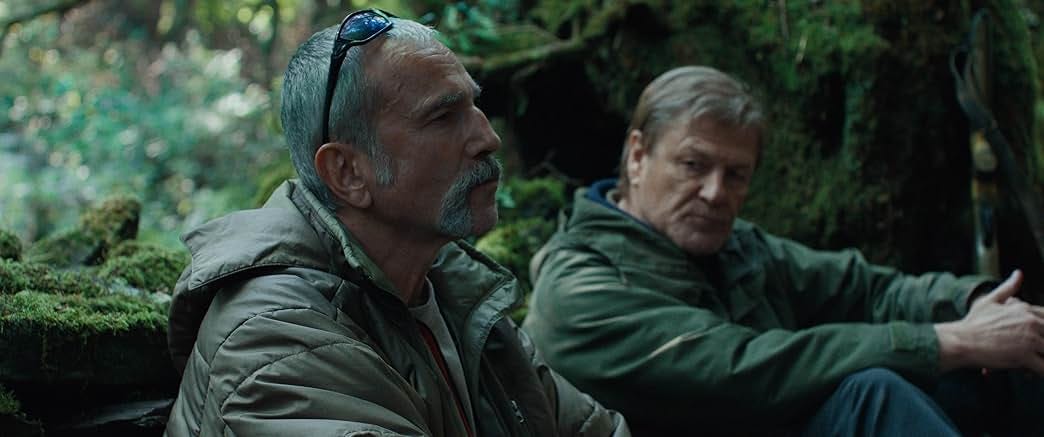
The brothers go for runs, take walks, swim and even spar. In one frame the waves lift and crash over them, in repetition. We lose and regain sight of the two as they stand in the ocean, each with an arm over the others shoulders, stumbling amidst the crashing water. There’s an anxiety here that animates the whole film. Jem and Ray dance across from one another to rock & roll. As they sway, jostle and jump toward each other there’s a feeling that they might crash; that if these two make contact, it will be an eruption.
Bottomley’s performance, along with the film’s cinematography, attempts to illustrate the inheritance of that potential eruption. When his mother Nessa (Samantha Morton) finally decides to tell Frank everything about his father, we see his image disrupted through a fish tank. Nessa recounts how Ray was before Frank’s birth and the conditions that would lead to his eventual abandonment. Nessa and Frank aren’t able to see eye-to-eye and there’s a way that Bottomley brings an energy to his speech that mimics Day-Lewis. It’s not a copy but an echo, familiar as it is terrible, that is inching closer. He rests his head against his folded hands, showing his still bruised knuckles. The neglected son who rejects the father and is thus doomed to replicate him.
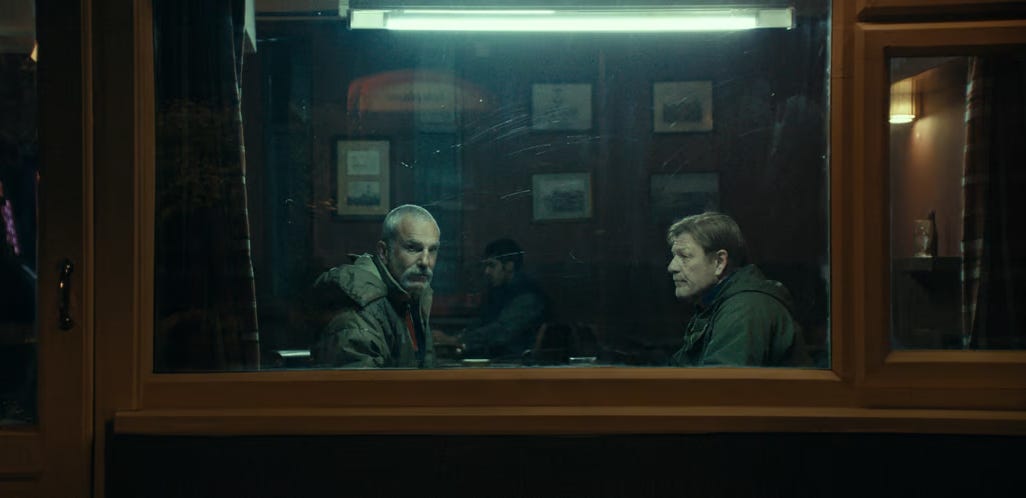
The cinematography throughout the film is resolute in its stillness— we’re made to really sit with moments. At its best this stillness amplifies what are stand out performances from Sean Bean and Daniel Day-Lewis. But much of this film’s lingering eye— in tandem with its small cast of unexplained spectral creatures— slackens a narrative rife with tension. Ray wakes to an apparition above his bed in the middle of the night and, as the first instance, it’s arresting and intriguing. It’s an especially effective image once Frank finds its physical referent: a polaroid of his mother Nessa as a young woman. As the figures become more abstract they merely distract. It’s as if the film betrays its faithfulness to the unfettered stillness that it goes to great lengths to establish. Suddenly, the character at rest, in contemplation of calamity becomes insufficient and requires some external agitation (re: the random ice storm in the film’s final act).
Anemone leaves viewers mesmerized by Daniel Day-Lewis’ return, delighted by its musical score and narrative familiarity. It’s a film with much to say about fatherhood, trauma, and surprisingly— war. For all those triumphs, it still manages to leave us a bit distracted by its odd phantoms and overall length.
Square One is free. But if you enjoyed this post, you can support by donating money to my friends [Alaa] and [Othman] striving to survive the genocide in Gaza, Palestine. Any amount helps.
An elegant review! Can't wait to watch this film!